The Right to Abstain and the Freedom Not to Vote
Democratic integrity is determined both by how many citizens cast a ballot and by the quality of voters: the extent to which they are well informed. Compulsory voting does a good job of increasing voter turnout and representation. With more communities expressing their views in a genuinely impactful way, you get a greater likelihood of the government in power serving and catering to a greater volume of stakeholders. All that said, mandatory voting is an extremely harmful policy that almost certainly does more harm than good. Freedom loses something fundamental when it ceases to be a choice.
There is, of course, a very strong case to be made for compulsory voting. First, we must question the reason for low voter turnout. One who assumes from the get-go that mandatory voting is unjustifiable may claim that abstention from voting is caused by those who are uninformed or disinterested in politics. Closer scrutiny reveals, however, that low turnout is socially uneven, wherein lower-income families fall into norm-driven cycles of systematic abstention, thereby undermining the principle of equal opportunity for participation.
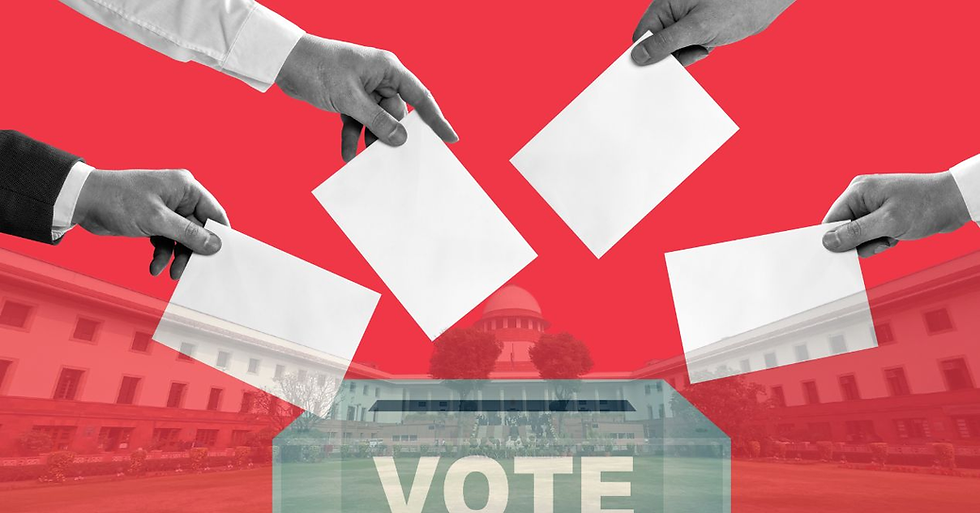
Compulsory voting would thus improve representation for lower-income households.
Furthermore, a government that is aware of certain communities that habitually abstain from voting will continue to ignore them in both campaign and policy. If we accept at face value the fact that the citizens from lower-income communities who regularly abstain from voting are the most vulnerable stakeholders, in that they are in a position to benefit most when acknowledged in policy and be harmed most when ignored, we find that a country where voting is not compulsory necessarily disserves the most vulnerable stakeholder. Meanwhile, in a country where these communities must vote regardless of whether or not they want to, running parties will actively try to garner these votes by appealing to these communities, thereby helping them in policy.
While these arguments present a strong case in favour of compulsory voting, the detriments brought on may well outweigh them. First comes the question of enforcement. If one plans to enforce compulsory voting through fines on non-voters as in Australia or Belgium, who is most impacted? The non-voters, as established, are often among lower-income families, which means the fines would only hurt them more. As such, mandatory voting would act as a regressive tax on the poorest citizens.

The response to this is in two parts: first, this would just incentivise them to vote more. Second: the fine could just be nominal, like $20. On the first point, it is likely that the communities where the norm of abstention is rooted deepest are of the lowest-income groups. This would mean that particularly resolute communities, quite literally the most vulnerable of the stakeholders, stand to lose the absolute most by this policy.
On the second point, and indeed in response to the entire notion of mandatory voting, one must question whether it is a good thing to have citizens who vote not out of public interest or opinions about policy but rather to escape a potentially harmful punitive charge, given that they may end up making the wrong choice for the country’s future. In the best case, it will have no effect, as in Australia where although the voting rate rose upon it being compulsory, a sizable fraction submitted a blank ballot. In the worst case, leaders are elected based on charisma or populist strategy, since those who have historically abstained are unlikely to pursue political literacy just because their ballot is compelled. They are much more likely to vote based on name, superficial impression, or reputation - thus making the country only more vulnerable to demagogues, populists, and the effects of political ignorance.
These communities are, therefore, also more vulnerable to vote buying. Given they are in desperate need of money and given they have to vote anyway, more malicious actors seeking power may well decide to pay off these communities to secure votes for themselves. The communities are, of course, likely to give in to this practice given their financial deprivation. While vote buying is prevalent regardless of whether compulsory voting exists or not, it is likely to be exacerbated if it does.
Secondly, on principle, to have the freedom to do something necessarily includes the freedom not to do it. Having freedom of speech means one is free to remain silent. If silence is prohibited, the country by definition does not have freedom of speech. Mandatory voting therefore violates democratic consent and actively weakens the right to freedom of voting, a stronger principle to uphold than equal opportunity for participation. How can a democracy preserve its claim to liberty while simultaneously compelling its most fundamental right?
A democracy may survive low turnout, but it cannot justify compelling political consent.
A democratic society that allows abstention may suffer from underrepresentation or asymmetrical opportunity. However, a society that compels one’s vote harms the stakeholders it claims to defend while simultaneously compromising the rights of the genuinely politically apathetic and exposing itself to vote buying.